Lithic Rage Manual (WIP)
Card Types:
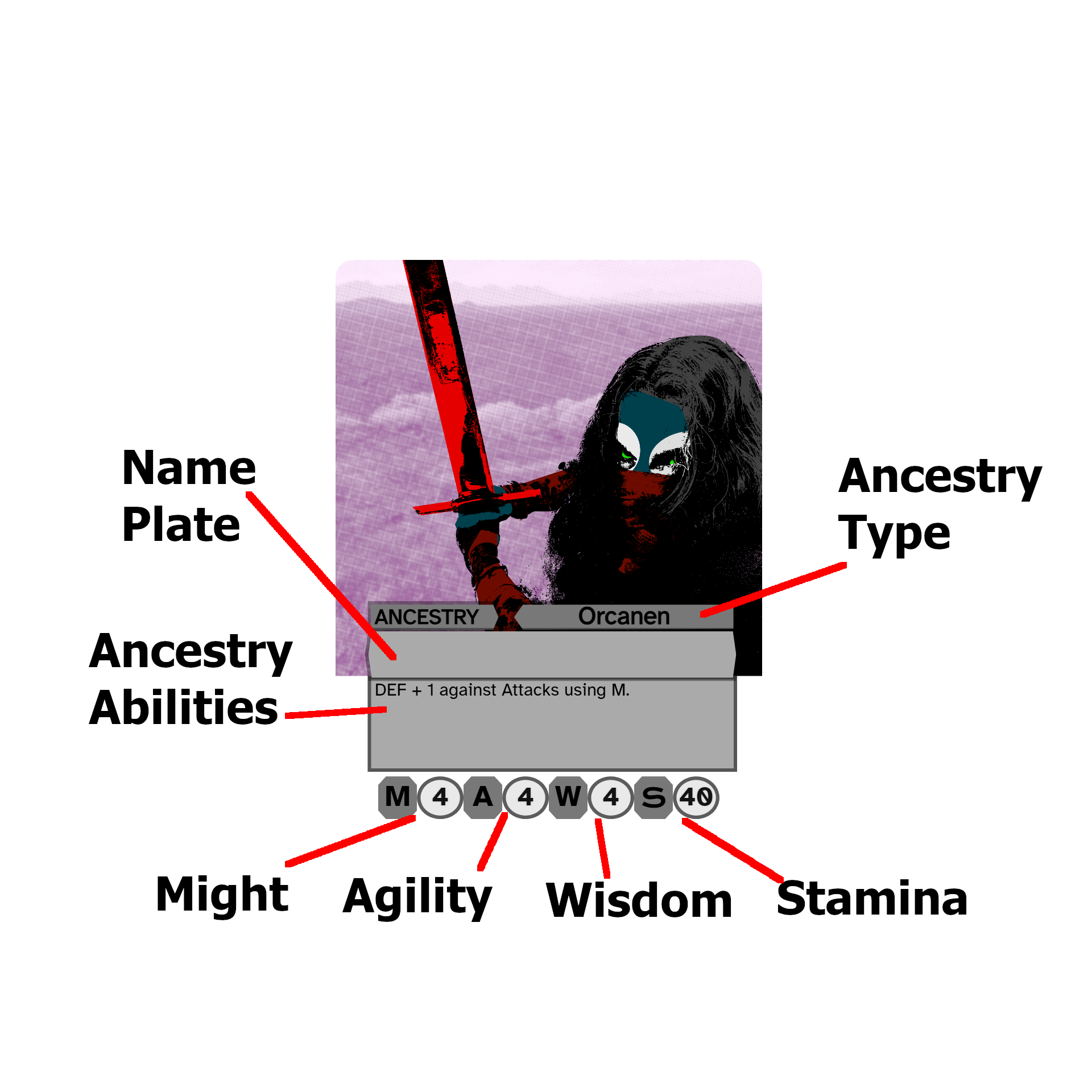
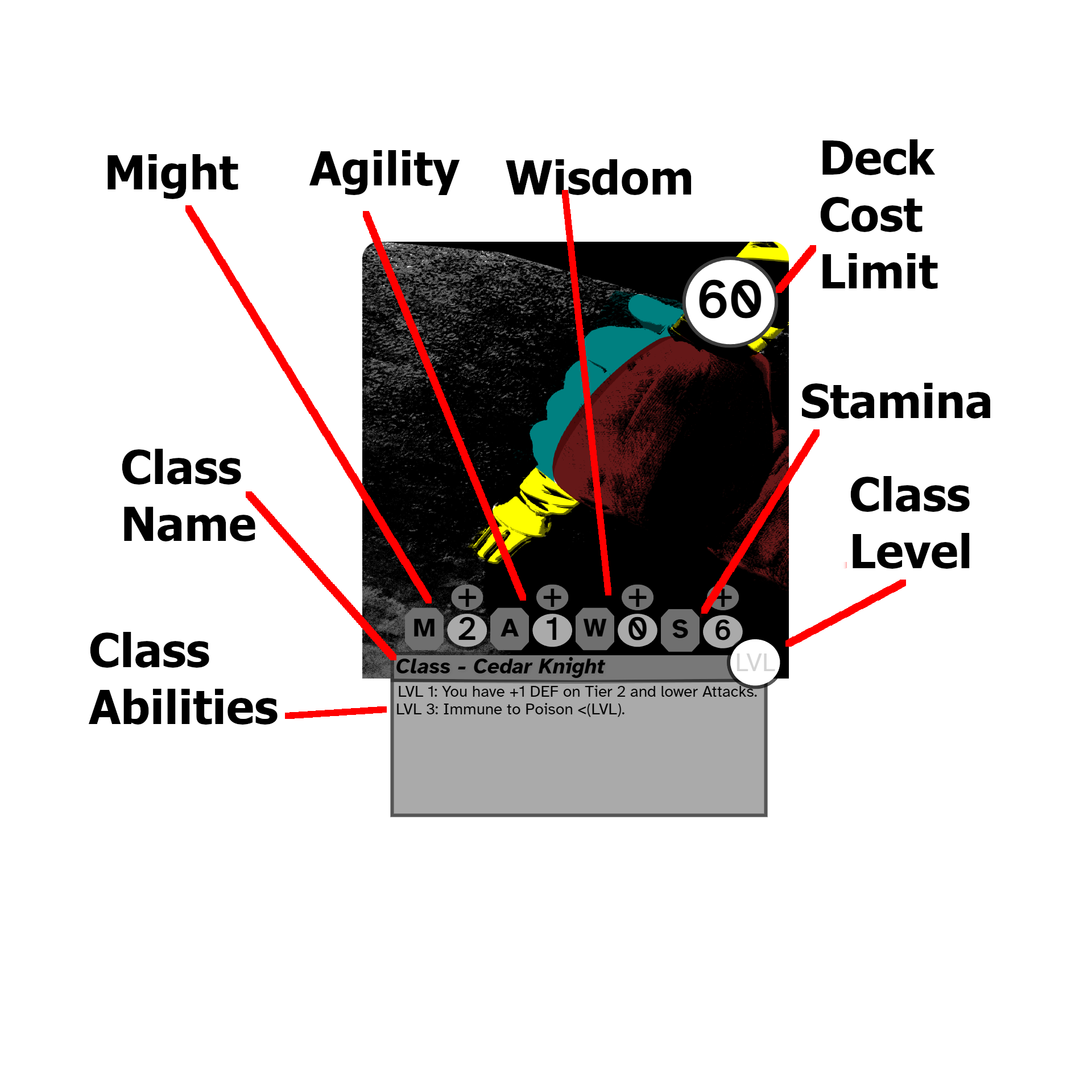
Ancestry and Class:
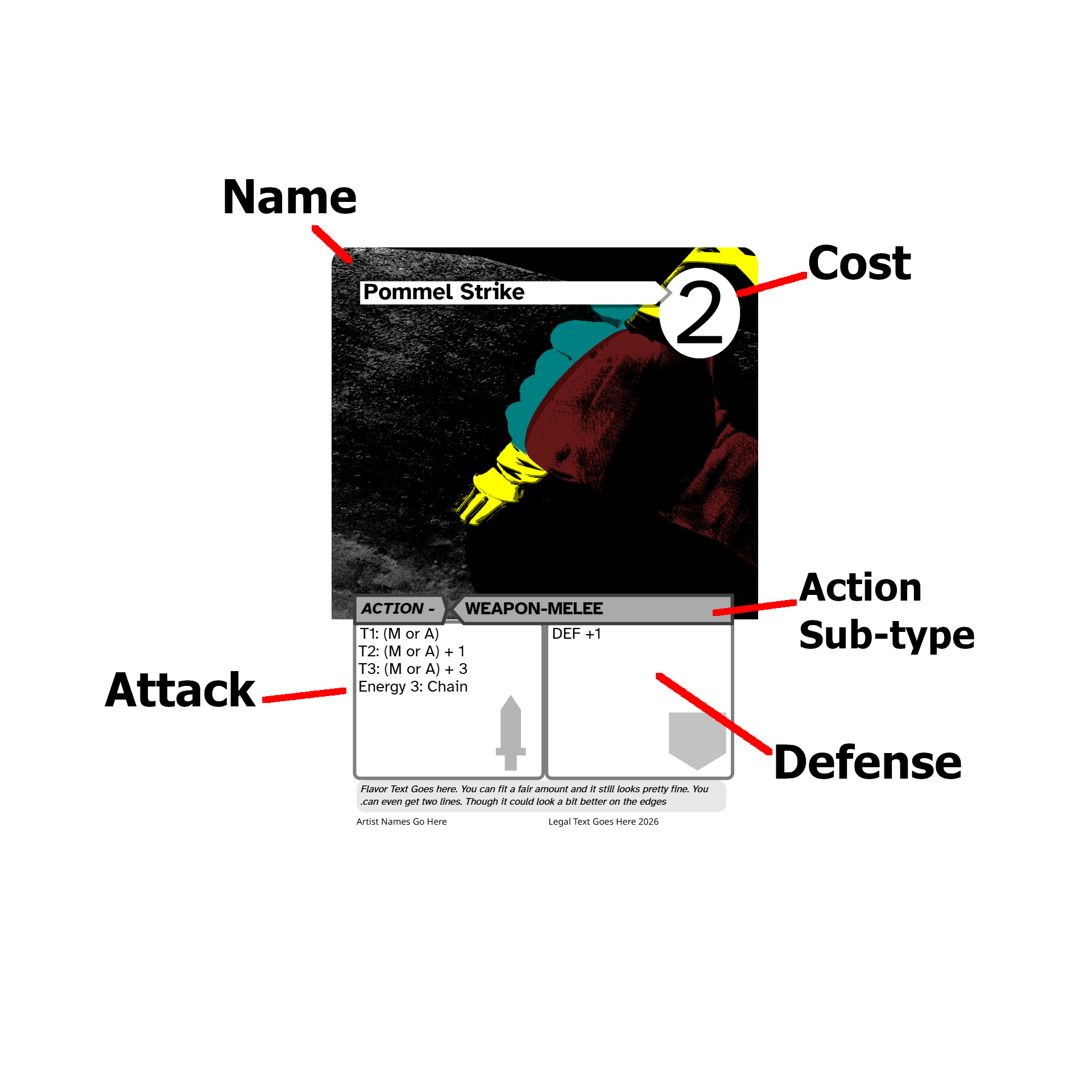
Action:
Condition:
Image TBD
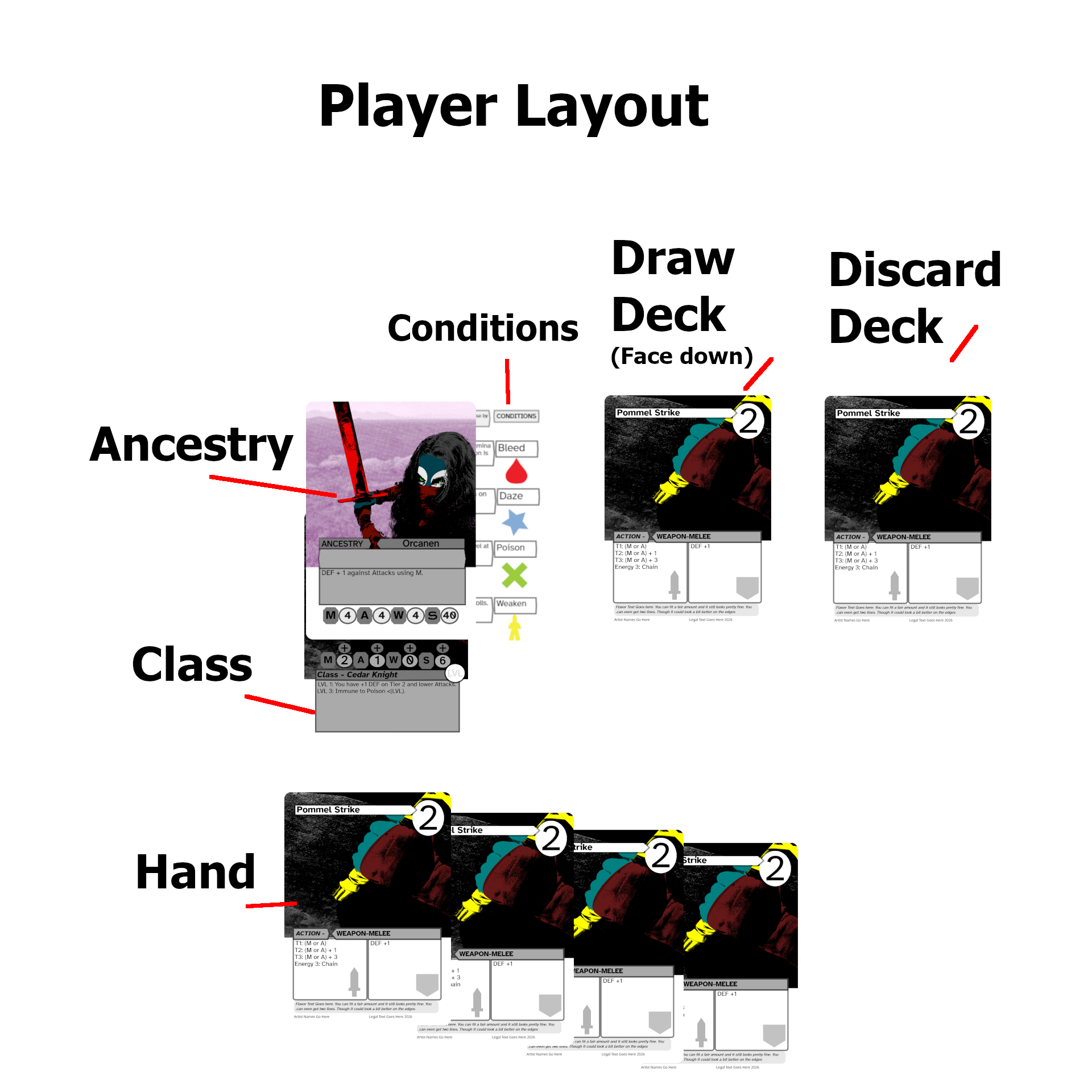
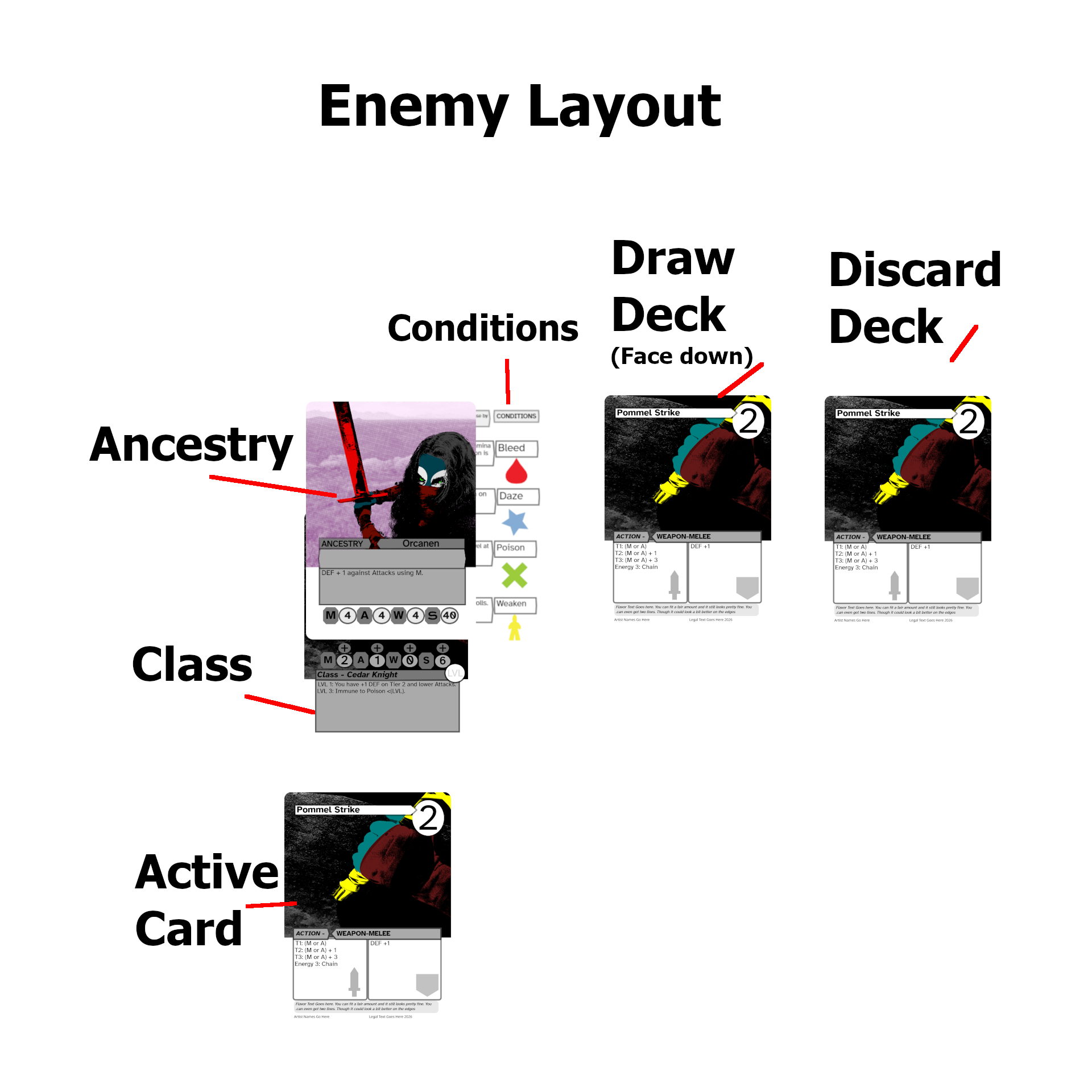
Layouts:
In order to keep track of the game you will also need some way to count a few things:
2x Stamina Counters: Stamina can be 40+ so some sort of dial counter is useful. Or use an app. You can also just write on a piece of paper!
2x Energy Counters: Each Combatant can have Energy up to 6 so a six sided die (1d6) works deliciously. When a Combatants Energy is 0, simply move the die out of the play area.
4+ Condition Counters: Conditions can get counted however you’d like— but a Condition card is included in the card pdf. Using 1d6 on top of each Condition icon on the card is the recommended route.
Building a Deck:
Your Combatant Character is made of a combination of Ancestry and Class cards. Each of these card types have values for Stats MAWS. The value of your Combatants MAWS stats is the combination of the two. *(If your Class has a M value of 2 and your Ancestry has a M value of 5 then your Combatants M value is 7.)*
The Class card is designed to be placed underneath the Ancestry card with the card power and stats visible. Abilities on the Class card require the Combatant to be at least the level labeled next to the power to be used.
The Condition card is an optional card for tracking the value of any current Conditions on the Combatant. It can be placed underlapping the Ancestry/Class cards and counters or dice can be used on top of each Condition label.
Each Action card has a Cost. The total Cost of all the cards in your deck must be less than or equal to the Cost value on your Class card. There is no deck limit on the number of cards in the deck. There can only be at most three copies of any specific card in a deck. *Each Action has a subtype (Weapon, Spirit, Body, Mind). Some card effects will reference these subtypes.*
**Leveling Up (WIP not implemented):**
When the Combatant has accrued enough experience through Matches they will level up. Upon level up their Stamina will increase by X, each of their stats will increase by Y (or by the values on their Class card) and their maximum Cost increased by Z. *This is WIP and will be fleshed out in the future. when full campaign progression is worked on*.
Upon level up the Combatants deck may be readjusted with cards added or replaced based on their new total Cost value and any reward cards they have received.
*For now all Combatants are considered Level 1. and cannot currently be increased in Level.
Match Play:
**Beginning of the match:** Each Combatant's Stamina counter is set to the sum of Stamina values their listed on their Ancestry and Class cards. Set each Combatants Energy counters to 1. Then Enemy goes first. Player and Enemy alternate taking turns until one of them reaches 0 Stamina.
**Turns of the match:** Each Combatant plays one Attack Action on their turn and one Defense Action during their Opponent's turn. The Attack ability on an Action card are the block of text with a sword icon. The Defense ability is the block of text with a shield icon.
**Ending of the match:** When the Stamina total of a Combatant reaches 0 or less, then that Combatant loses the match.
Enemy Turn:
*Rules that refer to "The Enemy (verb).." means the human player performs those tasks for the Enemy.* *The Player and Enemy are separate gameplay entities but require the human playing the game to use and resolve Actions and abilities for both.*
Enemy gains 1 Energy to a maximum of 6. Player draws cards one at a time from their Draw deck until their hand has 4 cards. Reveal top card of Enemy Draw and resolve that Action.
If that Action is an Attack with a Power Roll then reveal the top two cards of Draw as the Power Roll then discard the Power Roll cards in the order revealed. After the Action is resolved then discard the Action card. *If the Enemy plays an Action with Chain then after that Action is resolved they repeat the above (Reveal top card of Enemy Draw and resolve that Action.).*
If the Enemy plays an Attack Action then the Player may play a Defense Action from their hand. Discard Defense Action after the Attack is resolved. (*Defense Actions reduce Damage from Attacks by their Cost, unless otherwise stated in the Defense text.*) If the Enemy plays an Attack Action and the Player has no Defense Actions in their hand they the Player does nothing.
When the Enemy has played at least one Action from the top of their Draw and have no more card effects to resolve then they end their turn.
If the Enemy reveals an Action that cannot be resolved as an Attack; they pass instead of playing the Action. Discard that card, and all Combatants gain that discarded card's cost in Stamina. *(This represents taking a breath and briefly pausing to regain stamina)*.
Player Turn:
Player gains 1 energy to a maximum of 6.
Player draws cards from their Draw deck one at a time until their hand has 4. Player plays an Attack Action. Or can pass. (*If the Player plays an Action with Chain then after that Action is resolved they draw more cards one at a time until their hand has 3 and repeat the above (play an Attack Action or Pass).*
When a Player plays an Attack Action; if that Action is an Attack with a Power Roll then discard two cards from hand and use their added costs as the Power Roll. After the Action is resolved; discard the card.
If the Player plays an Attack then reveal the top card of Enemy Draw and use its Defense Action. Discard Defense Action after the Attack is resolved. (*Defense Actions reduce Damage from Attacks by their Cost, unless otherwise stated in the Defense text.*)
Player can pass instead of playing an Attack Action. You may discard a card from your hand, and all Combatants gain that discarded card's cost in Stamina. *(This represents taking a breath and briefly pausing to regain stamina)*
When the Player has no more cards in hand to play then they end their turn.
**Running Out of Cards to Draw**:
Whenever Player or Enemy Draw Deck reaches 0 cards, immediately shuffle their Discard pile and use as a new Draw Deck, Then the Player immediately loses (Lvl * 3) Stamina and skips their next turn. Enemy does not lose Stamina or skip their next turn when shuffling their Discard into their Draw.
Rolling:
When "rolling" the Player reveals cards from their hand and uses the cost value of the cards as their roll. The Enemy reveals the cards from the top of Draw. After the cards are revealed they are placed in the Combatants discard pile before any other effects that were rolled for are resolved.
**Roll:**
Attack Action cards with Rolls will roll for Tier of card effect when played.
A Player Power Roll discards two cards from hand and use their total added costs as the Roll then discard the Power Roll cards in any order. If the player does not have two cards to discard for a Roll then they can not perform the Ability.
An Enemy Roll reveals the top two cards of Draw and use their total added costs as the Roll then discard the Power Roll cards in the order they are revealed.
Tier 1 = <=5
Tier 2 = 6-9
Tier 3 = 10+
Crit = Natural 12. *(Natural means a raw value before any modifiers.)*
Crit on Attack card rolls that Attack gains Chain *(allow an extra Attack card to be played on that turn).*
Edge: When you make a roll with an Edge, you gain a +2 bonus to the roll. If you make a roll with two or more Edges, you have a Double Edge. With a double edge, you don’t add anything to the roll, but the outcome of the roll automatically improves one tier (to a maximum of tier 3). A Roll cannot be increased beyond Double Edge.
Bane: When you make a roll with a Bane, you take a −2 penalty to the roll. If you make a roll with two or more Banes, you have a Double Bane. With a Double Bane, you don’t subtract anything from the roll, but the outcome of the roll automatically decreases one tier (to a minimum of tier 1). A Roll cannot be decreased below Double Bane.
Energy:
Combatants gain 1 Energy at the start of their turn. Card effects with "Energy X" require the user to lower their Energy total by that amount to use the effect listed after the "Energy X" text. Energy cannot be increased beyond 6 or below 0. If an Energy cost requires reducing Energy below 0 it cannot be used.
Glossary:
Action:
Attack:
Cost:
Defense:
DEF: Numerical value of Defense. This reduces Damage from Attacks by the value.
Power Roll:
Match:
Draw: Noun. Short for Draw deck.
draw: Verb. Pick up a card from top of Draw deck.
Discard: Noun. Short for Discard pile.
discard: Verb. To put a card face-up on top of the Discard Pile.
Lvl = Level of Combatant.
Level: Level of Combatant.
Chain: if a card has Chain then the user must play another Attack during that turn.
Damage: amount of Stamina to reduce.
Combatant: a participant in the match
Opponent: the other character that the current character is attacking
Player: human person controlling their own deck.
Enemy: The non-person Opponent the player is fighting
Chain: perform another Attack action after current action is resolved.
Energy:
M: Might
A: Agility
W: Wisdom
S: Stamina
--------------------
Conditions:
Conditions are applied with a number of that Combatants turns for duration. (So if Bleeding 3 is applied a Combatant; it is active for three of that combatants consecutive turns.)
Decrement each Condition counter duration by one at the start of the Combatants turn before any Condition effects resolve.
When an existing Condition is reapplied use the highest number for the new duration. Durations do not add together.
**Bleeding**
While a Combatant is bleeding, and uses an Action; lose Stamina equal to it's Cost after the Action is resolved.
**Dazed**
Combatant who is Dazed can only play one Attack Action on their turn.
**Poisoned**
Combatant loses Stamina equal to their Level at the end of each of their turns.
**Weakened**
Combatant takes a Bane (-2) on Power Rolls.
---------
Stats:
Characteristics
Each Combatant in the game has four characteristics that represent their
physical and mental prowess.
Might (represented by M in abilities and other features) represents
strength and brawn. A Combatant’s capability to break down doors, swing
an axe, stand up during an earthquake, or hurl an ally across a chasm is
determined by Might.
Agility (A) represents coordination and nimbleness. A Combatant’s
capacity to backflip out of danger, shoot a crossbow, dodge an
explosion, or pluck keys from a guard’s belt is determined by Agility.
Wisdom (W) represents a logical mind and education. A Combatant’s
capacity to solve a puzzle that unlocks a door, recall lore about
necromancy, decipher a coded message, or blast a foe with psionic
power is determined by Reason.
Stamina (S) represents health and vitality.
**The Golden Rule**:
The rules text of a card always overrides the rules printed in the latest version of the rules.
**Do-What-You-Can Rule**:
If a card effect tells you to do something that cannot be done (or can only be partially done) in the game, do what you can and continue play. This rule does not apply to the costs of cards and effects.
**“May” Rule**:
When a card effect has the word “may” in it, then there is an effect that you have the choice to do or not. Otherwise you must do what you can on that card.
**Ownership**:
The owner of a card is the Combatant who brought the card to the game in their deck. All cards revert back to their respective owner after a game ends or when it is discarded.
**Parentheses Text in Card Powers**:
When you see parentheses in a card power with italicized text inside, it is explaining how a card can be used. It is NOT part of the normal timing sequence of the game. Sometimes text in parentheses will explain special rules for the card that would normally break or change a rule.
**Stat Options:**
If an effect has "M/ A/ W" or any combination then choose the highest stat and calculate based on that highest stats value.
**Choice Effects for Enemy:**
If there is a card effect that lets the user choose a number in order to resolve the effect: if the Enemy is using the effect roll a six-sides die (1d6) and use that value for the choice.
**Table Rules:**
For your own match you are welcome to alter rules in order to have a more fun and engaging experience. One suggestion is to make sure it is fair to both Combatants. *(So if a table rule is to make all Attacks cause Daze 5; then both Combatants' Attacks will do Daze 5.)*
### Alternate Modes:
#### Multiplayer PVE
For each additional player either:
-Add the Enemys total life to the total Enemy (so double its life for 2 players or triple it for 3).
-Add an additional enemy with its own turn (but may share the deck if its the same Enemy type/class. If it is an additional enemy type then that Enemy has its own deck.
When an Enemy attacks it targets the last player to damage it. If no Player has yet damaged it then it attacks the player who went first in the match.
To track Enemy targets you may use an object on the Enemy card pointing at the combatant at the table it is targeting.
#### Multiplayer PVP
The game should "just work" if two Players have a match against each other. Ignore Enemy Turn rules and use Player Turn rules for both Combatants.